

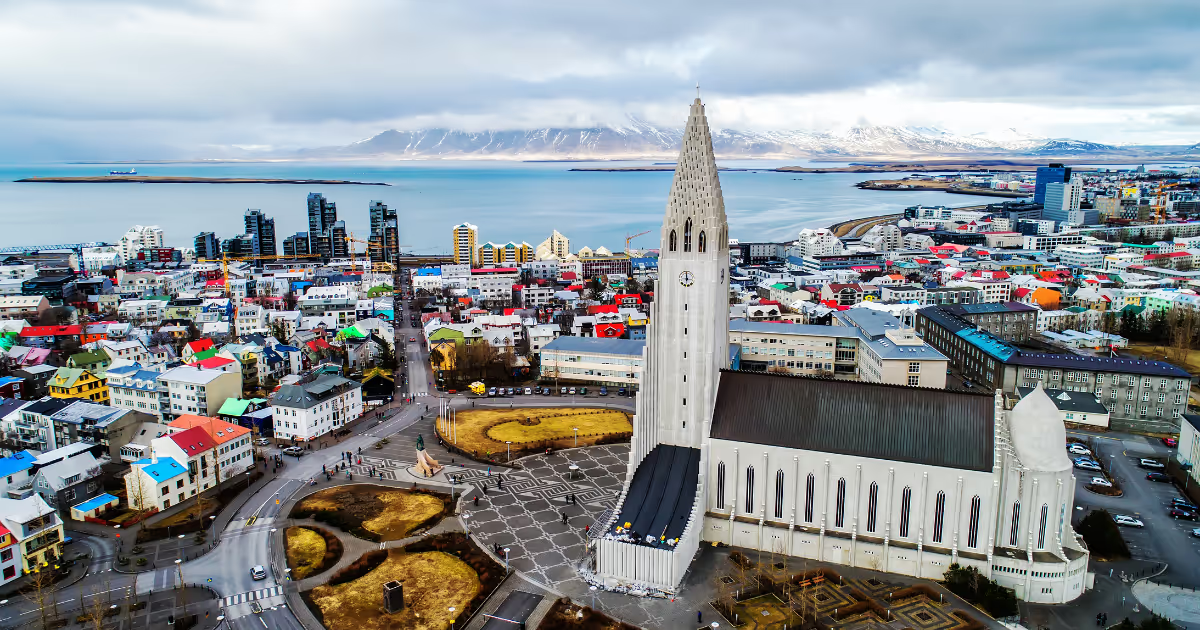
As of September 1, 2025, Life Cycle Assessments (LCA), locally referred to as Vistferilsgreining, are now a mandatory requirement for new building permits in Iceland. The Housing and Construction Authority (HMS) has set the regulations, requiring the industry to account for buildings’ total climate impact.
The Building Regulation (Byggingarreglugerð) requires everyone to quantify the carbon footprint of new constructions. Unlike previous voluntary guidelines, a confirmation of submission to the HMS portal is now a prerequisite for obtaining a building permit. Now that it is no longer optional, how should you approach these calculations?
What Needs to be Calculated?
In most of Europe, operational carbon (heating and electricity) is the primary target for reduction. However, because Iceland runs on renewable geothermal and hydro energy, the operational carbon from energy use (Phase B6) is exceptionally low. This means that for Icelandic projects, embodied carbon, the emissions from extracting, manufacturing, and transporting materials, becomes the dominant factor. Managing the "climate impact of materials" (Loftslagsáhrif byggingarefna) is the only way to significantly lower a project's total footprint.
Key Phases of the HMS Regulation
The regulation focuses on four primary life cycle stages:
- A1–A3 (Production): Raw material extraction and manufacturing. This is critical for managing the high footprint of imported materials.
- A4–A5 (Construction): Transport to the site and the construction process itself. In Iceland, the carbon intensity of Atlantic shipping routes (A4) must be specifically accounted for.
- B (Use Phase): Maintenance and operational energy.
- C (End-of-Life): Demolition and waste processing.
The Shift to Specialized Tools
While early estimates were often handled in Excel, the HMS requirements demand a level of precision that manual methods struggle to maintain. It is time consuming and often relies on a consultant with LCA expertise. Performing these calculations manually allows a lot of room for error.
- A single wrong formula can invalidate your report.
- If the design changes, manual recalculation is required which will be time-consuming.
- Properly assessing Loftslagsáhrif byggingarefna requires specific data for imported versus local materials which increases the complexity.
Reduzer: Tailored for the Icelandic Market
To ensure compliance without slowing down the project, the industry is moving toward dedicated LCA software. Reduzer is a specialized LCA software designed to simplify compliance with HMS regulations.
1. Full Regulatory Compliance (HMS Ready)
Reduzer provides pre-configured templates that align directly with HMS standards. It streamlines the submission of the required Excel results sheet and ensures your report is structured correctly for the HMS submission portal.
2. Eco-Certification (Vistvottun)
Many Icelandic developers aim higher than the legal minimum, seeking Vistvottun such as BREEAM or the Nordic Swan Ecolabel. Reduzer handles both the mandatory HMS reporting and the specialized credits for international certifications within a single workflow.
3. BIM Integration & Dynamic LCA
Reduzer integrates directly with your BIM models (e.g., Revit). The system automatically extracts material quantities and maps them to carbon data. This enables Dynamic LCA, allowing architects to swap materials in the model and see the instant impact on the building’s total Kolefnisspor.
4. Verified EPD Library
Access to accurate data is the only way to avoid "safety penalties." Reduzer offers a library of 15,000+ verified Environmental Product Declarations (EPDs). This allows you to use verified manufacturer data instead of generic averages, significantly lowering your reported carbon footprint.
Ready to simplify your LCA process? With Reduzer, you can ensure compliance while reducing embodied carbon.